For the past few years, the dominant narrative around AI and employment has been that “machines will replace people.” From programmers and designers to customer service representatives, translators, and content creators, nearly every major leap in model capability has triggered another round of debate over which jobs will disappear first.
But as “AI + industry” moves from concept to real-world deployment, the labor market is beginning to tell a different story. According to the latest AI Talent Mobility Report released by Maimai Talent Intelligence, the number of newly posted AI jobs across new-economy sectors increased 789.47% year over year between January and July 2026, nearly nine times the level seen a year earlier. AI-related roles now account for 32.62% of all newly posted positions, while the average monthly salary has reached RMB 63,160, up 2.74% year over year. In other words, roughly one in every three newly posted jobs in these sectors is now related to AI.
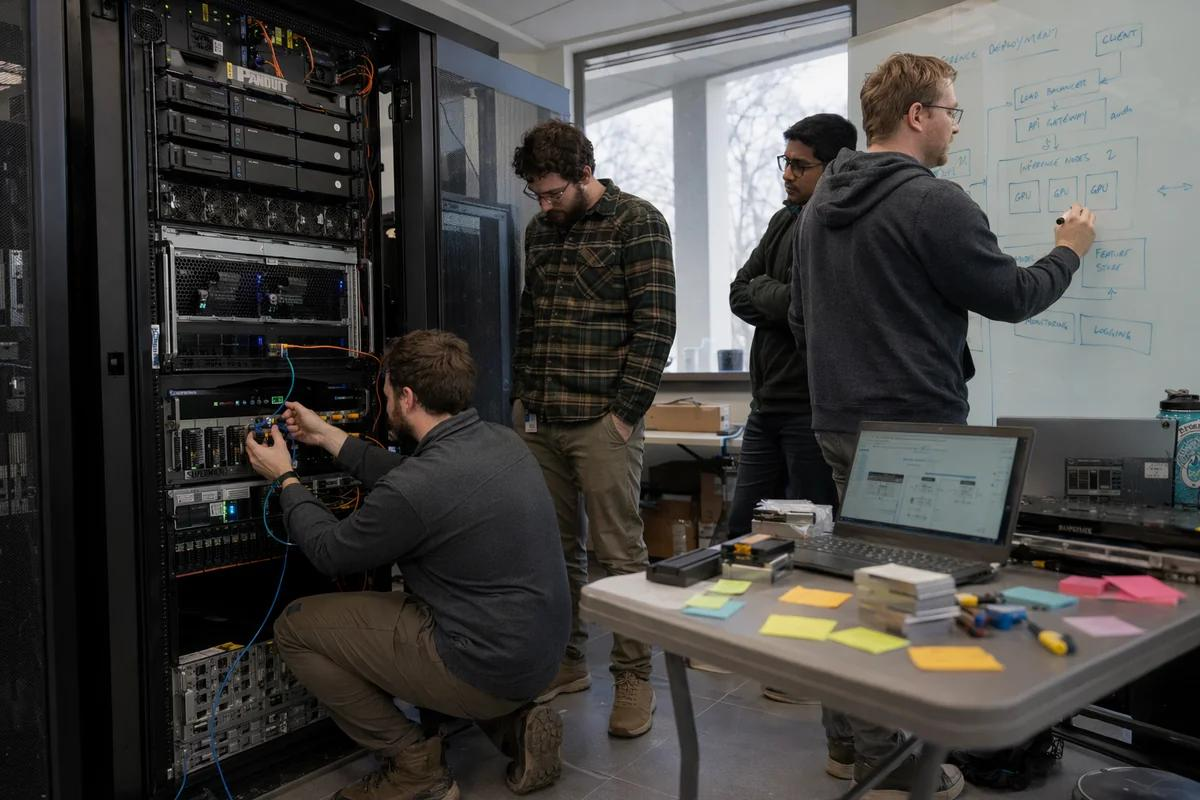
Importantly, these new positions should not simply be understood as conventional “AI engineer” jobs, nor are they being created only by pure-play AI companies. A growing share of hiring demand is coming from traditional industries undergoing AI transformation. As banking, manufacturing, retail, automotive, healthcare, and other sectors begin integrating AI into their products, operations, and business processes, new talent gaps are emerging for roles that either did not previously exist or did not previously require AI capabilities.
AI Hiring Is Shifting From “Building Models” to Bringing AI Into Every Industry
One of the fastest-growing roles this year is the Forward Deployed Engineer (FDE). Hiring for FDEs increased 1,522.73% year over year, making it the fastest-growing AI technical role. Among non-technical positions, AI Product Manager hiring increased 120.54%. At the same time, AI application development now accounts for 60.97% of newly posted AI roles, well above the 24.55% share for foundational AI technology positions. Roles in Agent application development, AI evaluation, and AI product management are also becoming increasingly important areas of recruitment.
These numbers reflect a broader shift in the stage of AI industry development. Over the past several years, competition centered largely on model training: who could build larger models, achieve stronger reasoning capabilities, and post higher benchmark scores. But as foundation models become increasingly mature, AI Agents are moving from standalone tools into enterprise workflows, while A2A, or Agent-to-Agent collaboration, is beginning to emerge. The industry’s focus is therefore shifting from “Is the model powerful enough?” to “How can AI actually be integrated into real businesses?”
For enterprises, the challenge is no longer simply whether a suitable model exists. The questions are now much more practical: How can a model be integrated into a banking system? How can AI be deployed inside a factory? How can it securely access internal enterprise data? And how can Agents become part of customer service, sales, R&D, supply chain management, and day-to-day operations?
A large language model cannot solve all of these problems on its own. The value of an FDE, for example, lies precisely in solving the “last mile” of enterprise AI deployment. Engineers need to work closely with customers, understand existing business systems, data structures, security requirements, and operational workflows, and then connect models and Agents with existing software infrastructure. The more capable AI models become, and the more industries AI enters, the greater the potential demand for professionals in integration, deployment, evaluation, product design, and business-process transformation.
The impact of AI on the labor market, therefore, is more accurately described not simply as job replacement, but job redefinition. Many positions that were previously centered around software, business expertise, or industry knowledge may gradually evolve into hybrid “AI + industry” roles. While technology is automating some repetitive tasks, it is also creating entirely new divisions of labor around new ways of working.
When Productivity Rises, People Do Not Necessarily Work Less — They Start Doing Things That Were Previously Too Expensive
One of the most common misconceptions about AI is to think of productivity gains as a simple subtraction problem: if ten people used to be required to complete a job and AI allows five people to do the same work, then the other five jobs must disappear.
Real economies do not always work that way. When technology dramatically lowers the cost of doing something, demand often expands at the same time. Greater efficiency in software development does not mean the total amount of software the world needs remains fixed. Lower content-production costs do not mean companies will always produce the same amount of content. Instead, when building an application, analyzing a dataset, producing a video, or deploying an intelligent system becomes significantly cheaper, demand that was previously uneconomical can suddenly become viable.
Suppose AI reduces the cost of a software project from RMB 1 million to RMB 200,000. The result does not necessarily mean the software industry will need only one-fifth as many people. Instead, thousands of small and medium-sized businesses that could not justify spending RMB 1 million on custom software may now become potential customers. As prices fall and the addressable market expands, the broader value chain around consulting, development, deployment, operations, and services can expand with it.
The internet provides a useful precedent. It certainly displaced some traditional jobs, but it also created entirely new categories of work in e-commerce operations, SEO, livestreaming, mobile application development, and cloud computing — many of which either did not exist before or existed only at a very small scale. Technology often begins creating employment at scale not when the underlying technology first appears, but when it starts integrating with industries across the economy.
The 2026 AI hiring data may be sending a similar signal. AI is evolving from a research tool concentrated inside a relatively small number of technology companies into a production tool being adopted across industries.
As AI Enters Every Industry, Jobs Are Not the Only Thing Growing — Inference Demand Is Growing Too
As more FDEs, AI product managers, and application engineers bring models into enterprise environments, another transformation is occurring at the infrastructure layer.
Training an AI model in a laboratory does not mean the AI application is finished. Once AI enters real business environments, every customer-service conversation, every code-generation request, every data-analysis task, and every step executed by an Agent requires inference. To complete a complex task, an Agent may need to read documents, call tools, verify results, and collaborate with other Agents. A single user request can therefore be broken down into dozens or even hundreds of model calls.
This is why the wider adoption of AI applications can lead to even greater demand for AI inference compute. Training determines the upper limit of what a model can do, while inference determines how often those capabilities can actually be used every day. Once AI enters core enterprise workflows, Tokens are no longer simply an occasional “conversation expense.” They become a systematic form of resource consumption that grows alongside the business.
Seen from this perspective, the fact that AI application roles now represent more than 60% of new AI job postings points to another growth curve underneath the labor-market data. More application development creates more real-world AI workloads; deeper Agent adoption creates more model calls; and as inference scales, enterprise priorities shift from simply asking “Can we use AI?” to asking “How can we use AI at lower cost, lower latency, and with greater reliability?”
This is the infrastructure layer that GoodVision AI is focused on.
GoodVision AI: As AI Enters Every Industry, Inference Needs Its Own Infrastructure
GoodVision AI’s core view is that as the AI industry moves from the model-training phase toward large-scale inference, enterprises need more than additional GPUs or access to more models. They need a way to match different models, compute resources, and enterprise workloads more efficiently.
Consider a manufacturing company deploying multiple AI Agents. Not every request requires the most powerful available model. Complex engineering reasoning may require a frontier model, while translation, summarization, and document organization can often be handled by lower-cost models. Production data may need to remain inside the enterprise environment for security reasons, while workloads requiring real-time responses may be better suited to edge infrastructure located closer to the factory.
GoodVision AI addresses this orchestration layer through its Smart Routing Engine. When an AI request enters the system, the engine can evaluate factors including task complexity, Token cost, response time, data sensitivity, regional compliance requirements, and node availability, then allocate the workload across different models and compute resources. In A2A scenarios, the system can also select suitable models and execution locations for individual Agent calls based on task objectives, capability requirements, cost, latency, and data permissions.
In other words, while an enterprise FDE may focus on answering “How do we bring AI into the business?”, the inference infrastructure needs to answer the next question: Once AI is integrated, where should this rapidly growing volume of AI requests actually run?
This is also part of the logic behind GoodVision AI’s AI Factory strategy. Compared with centralized data centers primarily designed for large-scale training workloads, AI Factories are intended to serve local and regional inference demand, bringing compute capacity closer to users, data, and real-world business environments. According to the company’s plans, projects are being advanced in Japan, South Korea, and the United States, with a long-term goal of connecting distributed AI Factories into a global AI Compute Grid in which compute resources can be dynamically orchestrated according to demand.
From cloud services to the Smart Routing Engine and AI Factories, GoodVision AI is building an infrastructure stack that connects enterprise AI demand, model selection, Token routing, and final compute delivery. As more industries begin deploying AI Agents, the problems addressed by this infrastructure will increasingly become part of everyday enterprise AI operations.
The Real Change May Not Be Whether Jobs Exist, but What Counts as a Job
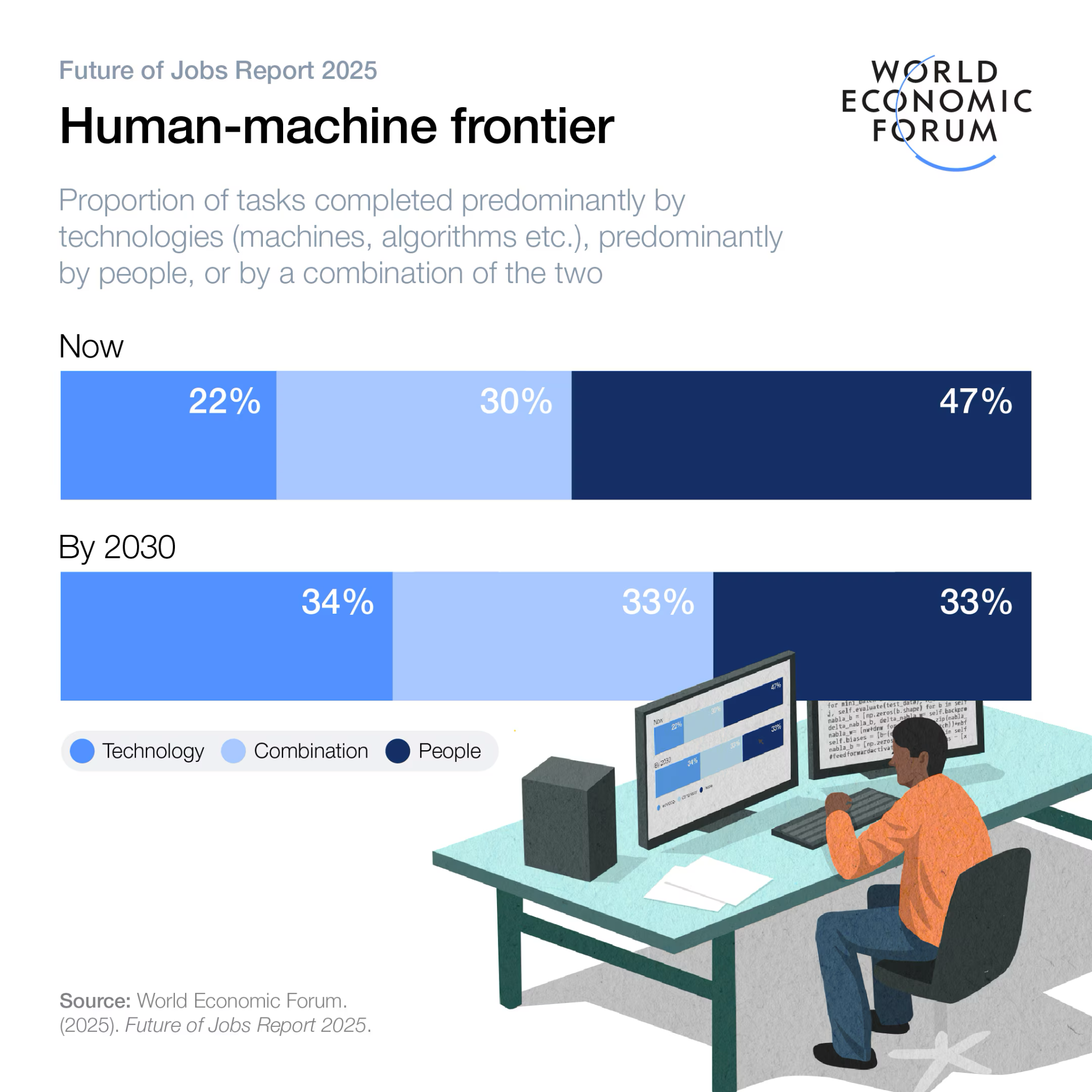
None of this means that every job will be protected from AI. Highly repetitive and standardized tasks that can be fully automated by models are likely to decline, and some traditional roles may shrink or disappear altogether. The World Economic Forum has previously estimated that by 2030, technological change, demographic shifts, the green transition, and other forces could displace around 92 million existing jobs globally, while creating approximately 170 million new ones — resulting in a net increase of about 78 million jobs.
That forecast is not specifically about AI alone, but it highlights an important and often overlooked point: technological transformation typically involves job creation and job displacement at the same time, rather than employment simply declining in a straight line.
The bigger challenge is that newly created jobs will not simply wait for the same workers in the same form. The latest Maimai data already reflects this transition. Enterprises do not only need people who know how to train models; they also need professionals who understand both AI and product development, people who understand models and customer environments, specialists who can evaluate Agent performance, and professionals who can integrate AI into industry-specific workflows. More roles that do not yet have standardized job titles may emerge across healthcare, manufacturing, finance, retail, and education, but many of them will require workers to understand AI as part of their core skill set.
The 2026 hiring data suggests that this transformation is already underway. As model capabilities improve, AI is entering real business environments faster, increasing demand for talent across product development, deployment, integration, operations, and industry transformation. At least for now, AI is not simply “deleting jobs” at scale. It is reshaping the nature of work itself: some repetitive tasks will be automated, but as AI becomes a new production tool across industries, new demand, new divisions of labor, and new professions will continue to emerge.
The question worth watching, therefore, is not only how many existing jobs AI may eliminate, but how many entirely new forms of work AI will ultimately invent.